Auto Policy 2026-31: What the Draft Means for EV Prices in Pakistan
The Prime Minister gave in-principle approval to the Auto Policy 2026-31 on 20 October, and the headlines are already declaring winners. Read the fine print first: the draft still needs the IMF, the Economic Coordination Committee, the cabinet and a finance bill before a single rupee changes at a showroom. With that said, here is what the approved draft actually proposes for anyone buying electrified, and who it helps or hurts.
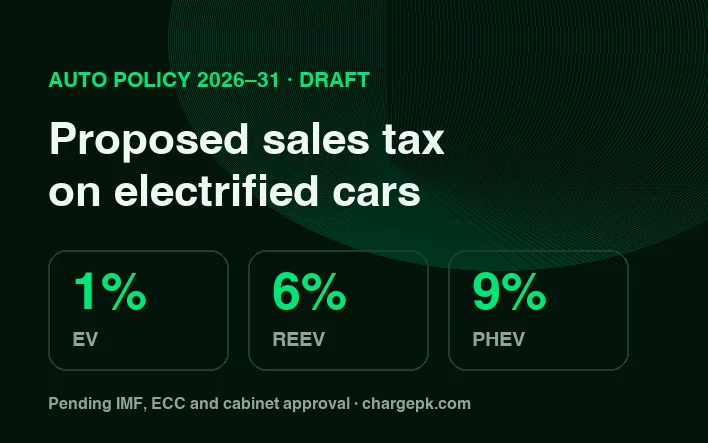
The proposed sales tax, by powertrain
| Powertrain | Today | Draft 2026-31 | Verdict |
|---|---|---|---|
| Battery EV (BEV) | 1% | 1% | No change, and the IMF’s push for 18% was rejected |
| Range extender (REEV) | ~1% (EV treatment) | 6% | The draft’s sting: the free ride ends |
| Plug-in hybrid (PHEV) | 18 to 25% | 9% | The biggest relief on the table |
Two more tax lines worth knowing: electric vehicles above $75,000 would carry a 10% federal excise duty, and a development levy on petrol cars (2% from 1001 to 2000 cc, 10% above that) would part-fund the EV incentive programme. How self-charging hybrids like the Toyota Corolla Cross Hybrid fare is not spelled out in the reporting so far, and we will not guess.
Who wins, in cars you can actually buy
- PHEV buyers, clearly. At 9% instead of 18 to 25%, the Jetour T2 i-DM, Haval H6 PHEV, Chery Tiggo 9 PHEV and KIA Sorento PHEV all stand to shed serious money if the draft passes as written. On a PKR 1.29 Crore PHEV, the difference between 18% and 9% tax is roughly PKR 10 Lakh before other charges, which is real negotiating territory. The July hybrid tax shock would be substantially unwound for the plug-in class; the full field is on our plug-in hybrids in Pakistan page.
- Small-EV buyers. Qualifying imported EVs under $15,000 would pay 5% customs duty for the first two years. That is the Kaiyi e-Qute 04 class, and it is the clause that could finally bring cars like the BYD Seagull within reach. Everything already under that ceiling lives on our EVs under PKR 50 Lakh page.
- Anyone financing. The EV loan cap would rise from PKR 30 Lakh to PKR 1 Crore, with the term stretched from three years to five. Once the State Bank issues the rules, most of the EVs on sale in Pakistan fit inside that envelope.
- Buyers generally: the draft also proposes capping booking payments at 20% of the car’s price with a price lock at booking, which would end the pay-full-price-wait-six-months-pay-again routine.
Who should read the draft twice
REEV buyers and sellers. Range extenders have been the market’s quiet winners precisely because they were taxed like EVs. Moving them from about 1% to 6% touches the Deepal S05 REEV, ArcFox T5, NEVO Hunter, XPENG L03 REEV and iCaur’s V27, a class that has produced the year’s strongest launches. On a PKR 1 Crore range extender, five extra points of sales tax is roughly PKR 5 Lakh. Whether makers absorb the 5 points or pass them on will be the story of early 2027, and if you were already planning a REEV purchase, the draft is an argument for sooner rather than later.
What that could mean, car by car
Indicative arithmetic on popular NEVs, using today’s ex-factory prices from our catalogue. It isolates the sales tax change alone, assumes makers pass it through fully, and holds every other duty constant, so treat it as the direction and rough size of the move, not a quote.
| Car | Price today | Sales tax | Indicative move |
|---|---|---|---|
| BYD Atto 3 (EV) | PKR 89.9 Lakh | 1% → 1% | No change |
| Deepal S05 REEV (REEV) | PKR 100 Lakh | ~1% → 6% | Up ~PKR 5 Lakh |
| ArcFox T5 (REEV) | PKR 1 Crore | ~1% → 6% | Up ~PKR 5 Lakh |
| NEVO Hunter (REEV) | PKR 1.1 Crore | ~1% → 6% | Up ~PKR 5.4 Lakh |
| XPENG L03 REEV (REEV) | PKR 1.1 Crore | ~1% → 6% | Up ~PKR 5.7 Lakh |
| iCaur V27 (REEV) | PKR 1.2 Crore | ~1% → 6% | Up ~PKR 6.2 Lakh |
| Chery Tiggo 7 PHEV (PHEV) | PKR 100 Lakh | 18 to 25% → 9% | Down PKR 7.6 to 12.8 Lakh |
| JAECOO J7 PHEV (PHEV) | PKR 1 Crore | 18 to 25% → 9% | Down PKR 8 to 13.4 Lakh |
| Jetour T2 i-DM (PHEV) | PKR 1.3 Crore | 18 to 25% → 9% | Down PKR 9.8 to 16.4 Lakh |
| Haval H6 PHEV (PHEV) | PKR 1.3 Crore | 18 to 25% → 9% | Down PKR 9.8 to 16.5 Lakh |
| KIA Sorento PHEV (PHEV) | PKR 1.6 Crore | 18 to 25% → 9% | Down PKR 12.6 to 21.1 Lakh |
The PHEV savings show as a range because the current rate differs by model (18 to 25% depending on how each was classified after the July concession expiry). Each car’s page carries its live price, and we update them the day any of this is enacted.
The bigger structural moves
- Import duties flatten. Fully built conventional imports converge on a uniform 15% customs duty by FY 2030-31, down from 50 to 100% today, with regulatory and additional duties phased to zero.
- Used imports open up. Commercial import of used cars up to five years old would be allowed, starting near a 40% regulatory tariff and phasing down. More competition for everything, used hybrids included.
- EV targets. The policy aligns with the NEV 2025-30 push: a 30% new-energy share of sales by 2030, an incentives programme reported at over PKR 100 billion, and expanded public charging infrastructure, which is the part we watch most closely: the live state of the network is always on the Pakistan charging guide and the charger map.
When any of this becomes real
In-principle PM approval (20 October) → IMF review → Economic Coordination Committee → federal cabinet → finance bill and notifications. The levy legislation is targeted for December 2026, and the policy period runs FY 2026-27 through 2030-31. Until those steps finish, every number above is a proposal, and today’s showroom prices stand. We track real prices daily across the catalogue and will update each car’s page the day anything changes for it.
Every price, tracked live
73 electrified cars with real Pakistani prices, and the one thing no policy document shows: exactly where each one charges.
Browse the catalogueFrequently asked questions
Is the Auto Policy 2026-31 already in effect?
No. The Prime Minister gave in-principle approval on 20 October 2026, but the draft still needs IMF clearance, the Economic Coordination Committee, federal cabinet approval and a finance bill before any rate changes reach a showroom. Nothing about today’s prices has changed yet.
Will electric car prices drop under the new auto policy?
For battery EVs the 1% sales tax simply continues, so no drop from tax alone. The real movement is at the cheap end: qualifying imported EVs under $15,000 would pay just 5% customs duty for the first two years. Financing up to PKR 1 Crore over five years would also put more EVs within monthly reach.
Will REEV prices go up?
That is the draft’s sting. Range extenders currently enjoy EV-equivalent treatment near 1%, and the draft moves them to 6%. If enacted as written, the Deepal S05, ArcFox T5, NEVO Hunter, XPENG L03 REEV and iCaur V27 face a real cost increase unless makers absorb it.
What happens to plug-in hybrid prices?
Relief. PHEVs that faced 18 to 25% after the hybrid concession expired would be taxed at 9% under the draft, the biggest proposed cut in the policy. It would help cars like the Chery Tiggo PHEVs, Haval H6 PHEV, Jetour T2 i-DM and KIA Sorento PHEV.
What is the 10% excise duty on expensive EVs?
The draft adds a 10% federal excise duty on electric vehicles valued above $75,000, roughly PKR 2.1 Crore at current rates. In today’s market that squarely covers the luxury tier, the Avatr 11 class and up, while mainstream EVs sit well below the line.
What about self-charging hybrids like the Corolla Cross?
The reporting so far does not specify HEV treatment. Self-charging hybrids such as the Corolla Cross Hybrid have paid 25% sales tax since July 2026, and whether the final policy touches that is unknown. We will update this page and the affected car pages when the final text answers it.
Will imported used cars get cheaper?
The draft allows commercial import of used vehicles up to five years old, starting near a 40% regulatory tariff that phases down toward 2030. That widens supply and pressures prices across the board, including the used hybrid market, though the early tariff keeps the effect gradual.
What changes for EV financing?
The draft raises the EV financing cap from PKR 30 Lakh to PKR 1 Crore and stretches the maximum term from three years to five. The State Bank still has to issue the enabling rules, but once live it would bring most of the EVs on sale in Pakistan within financed reach.